

By Jennifer Worley, Interior Design Principal, EDAC, RID, LSSYB, CHID
The Psychology of Space: How Human-Centered Design Shapes Experience, Healing, and Wellbeing
People experience space emotionally before they understand it cognitively.
Before we admire materials, interpret branding, or understand programs, our nervous system has already formed an opinion. We instinctively assess: Am I safe here? Can I trust this place? How am I supposed to behave?
This response happens in milliseconds. And it happens every time.
Design is not simply visual. It is biological. Every ceiling height, every corridor turn, every shift in light, texture, or sound sends a message. The question is not whether our buildings communicate. It’s whether they communicate intentionally.
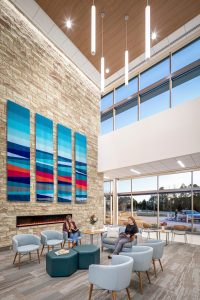
The Emotional Life of Buildings
Across disciplines—psychology, neuroscience, architecture—research continues to affirm what designers have long sensed: human beings scan their environments for safety and clarity before anything else. Sensory input shapes emotion faster than conscious thought. The body reacts before the brain explains.
This is why certain spaces calm us instantly, while others heighten tension without our fully understanding why.
Maslow’s Hierarchy of Needs provides a familiar framework: until physiological and psychological safety are established, higher-order experiences like learning, collaboration, creativity, and healing remain compromised. If a person feels exposed, disoriented, overstimulated, or vulnerable, their capacity shifts toward protection rather than participation.
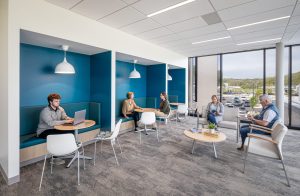
Neuroarchitecture and neuroaesthetics expand on this idea, demonstrating measurable connections between the built environment and stress levels, cognitive performance, and emotional regulation. Access to daylight influences circadian rhythm and mood. Natural materials can reduce physiological stress markers. Spatial proportion affects the perception of control. Clear wayfinding reduces cognitive load.
In short, design decisions are never neutral. They either support human regulation, or they undermine it.
Instinct and Environment
Humans evolved in environments that offered both prospect and refuge: the ability to see outward while feeling protected. We are drawn to layered depth, filtered light, natural textures, and patterns that echo organic systems. These preferences are not trends. They are instincts.
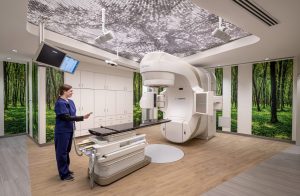
Biophilic design formalizes this understanding by identifying patterns that consistently promote comfort and wellbeing, visual connection to nature, variability in light and shadow, material authenticity, and moments of controlled risk or transition. When thoughtfully integrated, these elements don’t simply beautify a space; they recalibrate the nervous system.
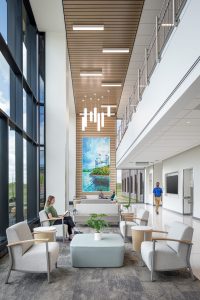
Similarly, frameworks like the WELL Building Standard translate human-centered design into measurable outcomes tied to health and performance. Daylight access, healthy materials, movement, air quality, and acoustics become performance drivers, not aesthetic afterthoughts.
The AIA Framework for Design Excellence expands the conversation further, emphasizing environmental integration, community connection, and long-term impact. Shaded edges, softened thresholds, intuitive circulation, and paths that clearly lead somewhere all contribute to a sense of coherence and belonging.
These frameworks are not checklists. They are lenses. They help designers see what the body is already perceiving.
Designing Earlier, Designing Better
The impact of psychology-informed design is directly tied to timing.
When conversations about human experience happen late, after major planning decisions are locked in, the opportunity for meaningful influence narrows. But when the question of experience is introduced during visioning and early schematic design, it shapes everything: massing, orientation, adjacencies, daylight strategy, circulation, material palette.
The earlier we ask, How should this space make people feel? the more aligned the outcome becomes.

Consider a healthcare environment. Anxiety is already present before a patient ever walks through the door. If the entry sequence is intuitive, daylight is abundant, materials feel grounded and natural, and sightlines provide clarity; the space begins regulating stress immediately. Without a single word, it communicates reassurance.
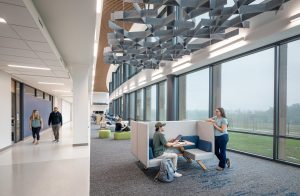
In a higher education setting, spatial design influences belonging and engagement. Informal gathering zones along clear pathways signal collaboration. Layered spaces that balance openness with refuge support both focus and social connection. The building teaches students how to inhabit it.
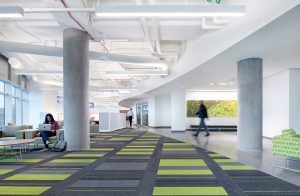
In research environments, clarity and environmental quality support sustained cognition and innovation. The absence of distraction becomes a form of generosity.
Across Healing, Learning, and Discovery, the underlying principle remains consistent: design shapes human behavior before we consciously recognize it.
Decoding the Experience
One way to sharpen intentionality is to practice decoding environments, both successful and unsuccessful ones. When standing in a space, ask, “What emotion is being regulated?” What behavior is being encouraged? Which sensory cues are doing the work?
A soaring cathedral regulates attention through verticality and light, encouraging reflection and awe. A diagnostic testing center that prioritizes visual clarity and acoustical calm reduces uncertainty. A hospital lobby grounded in natural materials and layered daylight begins lowering cortisol levels upon entry.
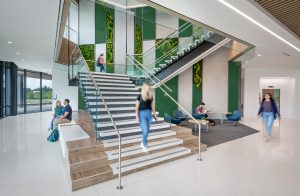
These effects are not accidental. They are the result of choices.
When designers understand the psychological implications of those choices, we move from composing buildings to shaping experiences.
What We Want Our Buildings to Say
Every project presents a fundamental opportunity: to align physical space with human needs.
If we accept that people experience space emotionally before they process it intellectually, then experience must be embedded early and reinforced consistently. This requires intentionality at every scale, from site orientation to interior detailing.
Design should not leave emotional impact to chance. Instead, we can begin each project with two deceptively simple questions:
- How should this space make people feel?
- What do we want it to say?
Because whether articulated or not, it is already speaking.
The work of designing for experience ensures that what it says supports safety, clarity, belonging, and possibility, exactly when people need it most.