

Designing for Staff Performance and Well-Being: A Multi-Site Study of Outpatient Clinics
Back To Articles
May 20, 2026
•
Knowledge, Research
•
Healing
By Zahra Zamani, Craig Puccetti, and Teri Joy
Research from multiple outpatient clinics shows that design decisions directly impact staff performance, efficiency & stress.
Design is operational infrastructure. Thoughtful clinic environments can meaningfully improve staff experience, efficiency, and care delivery.
Background
The physical design of outpatient clinics plays a critical role in shaping staff satisfaction, workflow efficiency, and perceived performance. While evidence-based design is increasingly emphasized, limited research has systematically examined how spatial layout, environmental quality, and zoning influence staff experience and behavior across diverse clinical contexts.
Objective
This study examines the impact of outpatient clinic layout and environmental attributes on staff satisfaction, stress, task performance, and communication. The goal is to identify high-impact zones and design factors that improve staff outcomes and operational resilience.
Methods
A mixed-methods design was used across four outpatient clinics within a unified health system. Data collection included behavioral mapping, Gemba walk-throughs, staff surveys, and multiple regression analyses. Quantitative and qualitative data were triangulated to evaluate spatial use patterns and environmental predictors of staff experience.
Results
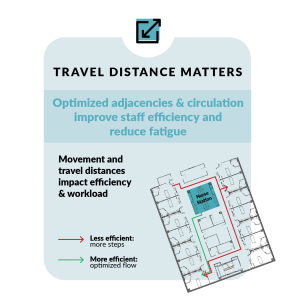
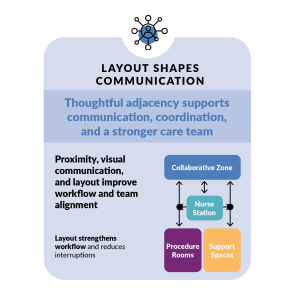
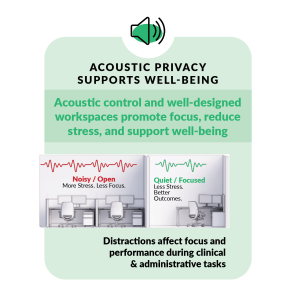
Key operational areas—nurse stations, exam rooms, and team rooms—were identified as multifunctional hubs. Their effectiveness was shaped by adjacency, workspace size, visual access, and acoustic privacy. Regression analysis showed that travel distance, spatial clarity, and wayfinding were significant predictors of satisfaction, performance, and reduced stress. Qualitative data reinforced the importance of ergonomic furnishings, access to restorative areas, and flexibility in reconfiguring underutilized spaces.
Conclusion
Outpatient environments that integrate spatial clarity, environmental comfort, and intuitive flow are essential for supporting staff experience and performance. These findings offer practical guidance for designing adaptable, high-functioning ambulatory care settings.
© 2026 BSA | Web Development By SFP