

What the Riley Children’s Hospital Maternity Tower Taught Us About Design Assist Done Right
The Building Already Knew What It Needed — We Just Had to Listen
There’s a moment in any complex renovation when the plan meets reality. A beam isn’t where the drawings say it is. An oxygen main runs directly over equipment that has to be replaced. A shaft doesn’t quite fit the way everyone assumed it would — two weeks before patients are scheduled to move in.
What happens in that moment depends almost entirely on the team you’ve built.
On a previous episode of BSA by Design, a roundtable of professionals who delivered the Riley Children’s Hospital Maternity Tower came together to talk through that project: what made it work, what nearly didn’t, and what they’d carry into the next one. The group included Andrew Gorman, Director of Facility Support Operations at Riley; Kevin Hutton, Director of Engineering Design and Construction at IU Health; Rod Foley, President of North Mechanical Contracting and Service; Kevin Silvius, Project Executive at North Mechanical; and Adam Posorske, former Director of Engineering and Principal at BSA.
What emerged was less a project retrospective and more a case study in what Design Assist actually requires — and what it makes possible.
Why This Project, Why This Model
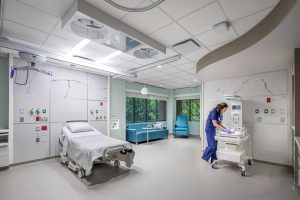
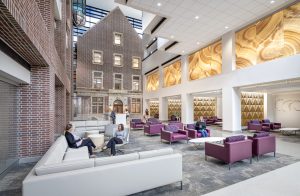
The Maternity Tower wasn’t just a renovation. It was a response to a public health crisis. Indiana’s infant mortality rate had long ranked among the worst in the nation, and Riley — as the state’s premier pediatric health facility — chose to do something about it. The answer was a five-story renovation of a building constructed in the 1980s: gutting the infrastructure, modernizing the systems, and converting what had been pediatric space into a facility capable of serving maternal and neonatal patients at scale.
This was not a project that could afford improvisation at the back end.
The team had a reference point to build from. Many of the same players had delivered the Simon Family Tower together under a full IPD model — the first IPD model in Indiana and a project that left enough of an impression that when the Maternity Tower came together, the question wasn’t whether to pursue a collaborative delivery approach. It was how to structure it.
Design Assist became the answer. The construction team, led by North Mechanical, was brought in during the design phase — not to review drawings after the fact, but to shape them in real time alongside BSA’s engineering team.
What Design Assist Actually Changed
In a traditional design-bid-build process, the design team produces a complete set of documents. The contractor receives those documents, re-coordinates everything, redraws much of it, and begins construction. The same work gets done twice. The people who will actually install the systems aren’t in the room when decisions are made about how those systems are configured.
On the Maternity Tower, that sequence was compressed and reordered.
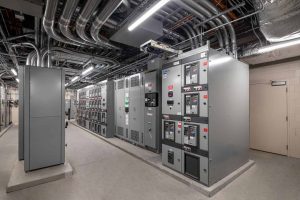
BSA’s engineers established design parameters, defined zones, and laid out primary distribution. North Mechanical’s team — including the detailer and the foreman who had previously worked the Simon Family Tower — took that framework and built out the full BIM coordination in parallel with design development. When a conflict surfaced, it surfaced early, when it could be resolved with a conversation rather than a change order.
“You draw it once,” as Rod Foley put it. That’s the efficiency. But the more consequential benefit was something harder to quantify: shared ownership.
Kevin Silvius described the mindset shift plainly. In a traditional delivery model, a contractor’s job is to install what the drawings show. In Design Assist, the contractor’s team is co-authoring those drawings. “I can’t sit through construction and say, ‘What’d you do that for?'” Silvius said. “I was right there the whole time. I own this design as much as BSA does.”
When the Building Pushed Back
The Maternity Tower pushed back constantly.
The basement was the most concentrated example. A cluster of aging air handling units needed to be replaced in a space threaded with high-voltage electrical lines, telecom runs, and a three-inch oxygen main serving the entire campus. Moving the oxygen line would have required a convoy of tanker trucks and a level of disruption the project couldn’t absorb. The AHUs had to be designed around it — sequenced, staged, and installed with tolerances measured in fractions of an inch.
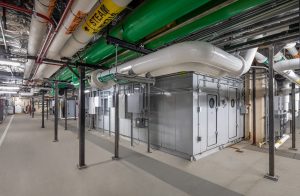
“Probably the highest coordination of air handling units I’ve ever done,” Posorske said. Having the contractor at the table from the beginning wasn’t a nice-to-have. It was the only way the puzzle got solved before anyone touched a wrench.
The fifth floor brought a different kind of discovery. When ceilings came down, structural beams weren’t where the 1983 drawings said they’d be. From that point forward, North Mechanical’s team scanned each floor before proceeding — building a verified picture of the existing conditions that let the design team adapt in real time rather than react in crisis.
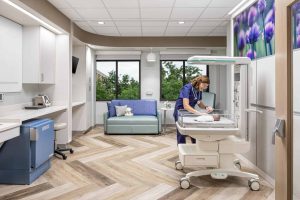
And then there was the C-section suite airflow problem. Two weeks before patient move-in, the team couldn’t hit the required airflow numbers. Investigation traced it to a shaft configuration that was creating more pressure drop than the model predicted. In a conventional delivery structure, that discovery triggers a formal change order process — quotes, approvals, schedules. On this project, someone sketched the fix on paper. North Mechanical went in, removed a section of shaft and ductwork, reconfigured the run, and hit the target. Patients moved in on time.
“If we were going through the process of change orders and quotes,” Hutton said, “it would have been a big problem.”
Trust Isn’t a Contract Term
Every person on that roundtable eventually circled back to the same word: trust.
Not the trust that a contract creates — that’s compliance, not collaboration. The trust they described is something that builds across projects, across conversations, across moments when someone could have protected themselves but chose instead to solve the problem.
Andrew Gorman, who had the unusual vantage point of beginning the project on the GC side before joining Riley’s facilities team, offered the most direct framing: “The people that ended up being there were the people that wanted to be there.” COVID hit mid-construction. Staffing became strained. Quality in some areas dipped below what anyone expected of themselves. The team didn’t fracture. They regrouped around a shared commitment to what the project was actually for.
That purpose wasn’t abstract. Kevin Silvius’s daughter underwent heart surgery as an infant and is now nine years old and healthy. Adam Posorske was fielding construction meeting calls at Riley while his son was admitted to the hospital upstairs. Rod Foley sat in a user meeting listening to burn unit nurses describe their patients — and said it reset everything. “At the end of the day, none of that other stuff really matters.”
That’s not a project management principle. But it’s what a high-performing team actually runs on.
Lessons for the Next One
The roundtable was candid about what they’d do differently.
Gorman acknowledged the owner’s role in establishing clarity — on scope, on decisions, on the definition of Design Assist itself, which can span everything from a constructability review to a fully integrated drawing process. Without a shared understanding of what collaboration means on a specific project, expectations diverge and disappointment follows.
Foley pointed to a gap in how the collaborative culture transfers to the broader workforce. The core team builds something real over months of early engagement. Then the crews arrive — pipefitters and ironworkers and electricians who’ve built their careers in a design-bid-build world — and they don’t have the context. The mindset has to be communicated deliberately, all the way to the field.
Silvius and Posorske both noted that the responsibility matrix could have been more precisely defined — who owns what, where the design intent ends and the contractor’s coordination begins. That clarity prevents the friction that emerges when assumptions collide late in a project.
And Gorman offered the observation that may be the most useful of all for owners considering this path: “Give us grace. Help us see the problems we don’t see. And understand that it’s hard to sell an alternate method when there isn’t hard data. It’s hard to tell a leader we need to do it this way because Rod’s a good dude.”
The ROI of Design Assist lives in avoided change orders, in accelerated schedules, in systems that get installed once by the people who coordinated them from the beginning. It lives in a C-section suite that was ready for patients. It’s real — it’s just harder to put in a spreadsheet than a line-item cost comparison.
What the Maternity Tower Proved
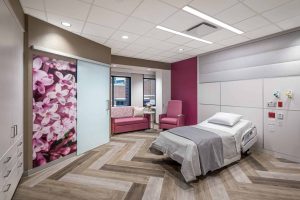
A forty-year-old building, landlocked on a dense urban campus, got transformed into a modern maternal and neonatal facility. The infrastructure was completely replaced. Systems that served occupied areas of the hospital stayed operational throughout. The project absorbed a global pandemic and still delivered.
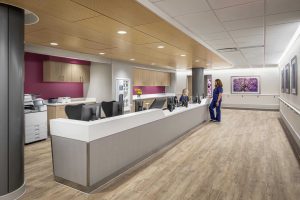
Gorman’s summary was simple: “To prove that we can do it, with the right team — I’m very proud of that.”
The right team. That’s always the variable. Design Assist is a structure that makes it easier to build one. It isn’t a guarantee. The contract can set the table, but the people still have to sit down, decide to collaborate, and keep choosing that when things get hard.
This team did.
BSA is an integrated architecture, engineering, planning, and interior design firm specializing in healthcare, higher education, and research facilities.