

How Integrated Project Delivery (IPD) Principles Transformed a Dying Mall into a Community Health Hub
When You Let Go of Control, You Build Something Better
There’s a moment in every complex project when the owner has to make a choice: hold tight to the reins or trust the team.
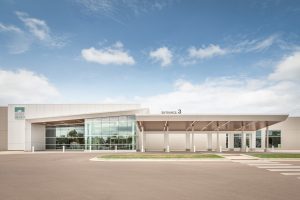
David Lenart, VP of Strategic Facility Planning and Operations for Columbus Regional Health (CRH), chose trust. And what came out the other side was NexusPark — a former regional mall reimagined as a multi-use health and wellness destination that’s already reshaping how an entire community experiences care.
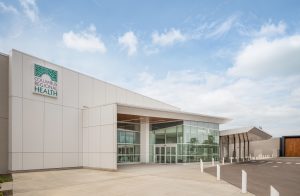
On a recent episode of BSA by Design, Lenart and BSA CEO Tim Spence sat down to talk through the project. What emerged wasn’t just a case study in adaptive reuse. It was a masterclass in what happens when integrated project delivery stops being a contract structure and becomes a genuine team culture.
The Problem Worth Solving
Columbus Regional Health had grown into a network of leased physician practices scattered across Columbus, Indiana — fifteen practices spanning primary care, specialty care, lab, and physical therapy, each operating in its own building, with its own workflows, and its own way of doing things.
The consolidation need was clear. What wasn’t clear was where to go.
The answer came through an unlikely partnership. Columbus Mayor Jim Lenup approached former CRH CEO Jim Bickel with a straightforward question: We have an aging mall at the center of town. Could we make it into something better?
The result was a 75/25 joint venture between the City of Columbus and CRH — a structure as unconventional as the project itself. The city’s Parks and Recreation division would anchor one end with an indoor sports complex. CRH would build a health hub at the other. Two organizations. One vision. A seamless facility designed so that, as Spence put it, “you really don’t know where one stops and where one starts.”
IPD Lite: Collaboration Without the Friction
Lenart was drawn to integrated project delivery before he’d ever practiced it. He’d read about the outcomes — better on schedule, better on budget — but what really pulled him in was the philosophy: a common playing field where architects, engineers, interior designers, the owner, and the contractor all had a voice regardless of their lane.
“Even though I’m an engineer,” Lenart said, “if I had a strong thought towards color or materiality, I should bring that up.”
Pure IPD, however, still carries friction points that can stall momentum. So the team did something pragmatic: they kept what worked and set aside what didn’t, building what Lenart calls “IPD Lite” — a bridging agreement designed to remove barriers rather than create them.
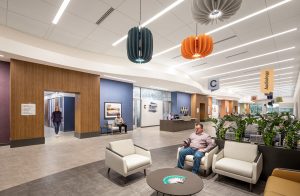
The physical manifestation of this culture was a Big Room, set up in a vacant mall storefront, where the entire team — owner, designers, contractors — worked through decisions together. Conditions of satisfaction and guiding principles stayed posted on the walls. When a decision came up, the team checked it against them. Not occasionally. Consistently.
The results showed. At project close, Lenart’s team went back and scored the project against those original conditions of satisfaction. “We nailed close to all of them,” he said — and was candid about the few they didn’t, framing those as learning assets rather than failures.
Tools That Made Collaboration Tangible
Good intentions don’t standardize fifteen physician practices. Tools do.
The team deployed FlexSim simulation modeling to visualize patient flow — how different check-in configurations would affect queue behavior, room utilization, and appointment timing — at a volume they’d never encountered before. It gave stakeholders something more persuasive than a recommendation: it gave them evidence.
Empathy mapping and Gemba walks helped the design team step inside the lived experience of staff — people who would spend eight hours a day in this space, not forty-five minutes like a patient. That distinction drove real decisions. When it became clear that one clinical area lacked access to natural light, the team added a skylight. No lengthy debate. It aligned with their conditions of satisfaction, and it went in.
Cardboard prototyping brought the on-stage/off-stage exam room model to life before a single wall was framed. Staff could physically walk through the flow — patients entering from one side, providers from the other — and build comfort with a change that was, at its core, a significant cultural shift. Doctors giving up “their” exam rooms is not a small ask. Letting people touch and experience the model before it was permanent made the difference.
Consensus Isn’t Found — It’s Shaped
Spence referenced a Martin Luther King, Jr. quote that reframed the entire conversation: “A genuine leader is not a searcher for consensus, but a molder of consensus.”
That’s what NexusPark required. The on-stage/off-stage model. Standardized exam rooms. Centralized versus decentralized registration. None of these were easy sells. But the team didn’t ask people to accept change on faith. They used data, prototypes, walkthroughs, and simulation to build a shared understanding — and then brought stakeholders along at every construction milestone so no one walked into the finished space as a stranger.
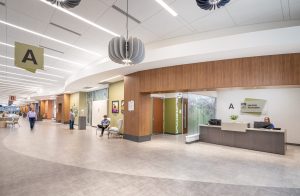
“I said I will have a failure in this project,” Lenart explained, “if one staff member comes to me after they walk in this space and said, ‘I don’t know where I’m at.'”
That didn’t happen.
What Adaptive Reuse Actually Looks Like
Spence was direct about what he saw when he first walked the mall: “It was pretty rough.” Teal accents, outdated skylights, an aesthetic so dated it was almost cool again.
But looking harder, the bones were there. Soaring floor-to-floor heights. Enormous skylights. Generous anchor-store footprints. Convenient perimeter parking. All of it connected back to the city grid.
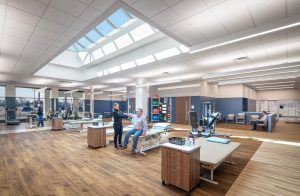
The challenges were real — long exam room runs created by a 180-by-350-foot footprint, acoustic complications from 20-foot ceilings, trenched slabs for plumbing, structural modifications for new air handlers, and a year-long COVID pause that halted the project entirely. But none of those were reasons to walk away. They were the price of working with existing fabric rather than starting from scratch.
“Do we need a new building for this?” is now a question Spence brings to every health care project. “Is there something we can reuse?”
A Community Landmark, Revisited
The finished NexusPark received two AIA Indiana Healthcare Design Awards — one for adaptive reuse and interior architecture, one for healthcare planning and applied research tied to the FlexSim modeling work. But the metric Lenart returns to isn’t the hardware.
It’s the Christmas decorating competitions between check-in areas. The chili cook-offs. The Halloween contests. It’s fifteen formerly siloed practices discovering that they’re a community — and that community is now the foundation for every operational change CRH wants to make going forward.
“NexusPark helps us implement those things now in a more community manner,” Lenart said.
And at the center of all of it is a simple lesson that applies well beyond Columbus, Indiana:
If you’ve done the work to build the right team, the best thing you can do is trust them.
BSA is an integrated architecture, engineering, planning, and interior design firm specializing in healthcare, higher education, and research facilities. To learn more about our work, visit bsadesign.com.